Quick Answer
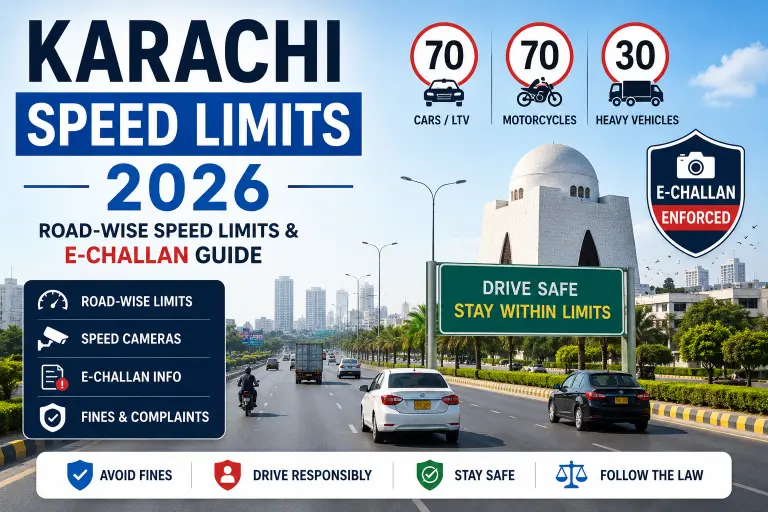
There is no single citywide speed limit in Karachi — it depends on the road, the vehicle category, and posted signage. As of a May 2026 DIG Traffic notification, cars, motorcycles, and light transport vehicles (LTVs) can travel at 70 km/h on Shahrah-e-Faisal, while heavy transport vehicles (HTVs) remain capped at 30 km/h. For every other road, always follow the posted signage.
2026 Update: Karachi’s Shahrah-e-Faisal speed limit was revised in May 2026 by the DIG Traffic office. Cars, motorcycles, and LTVs can now travel up to 70 km/h, while the HTV limit remains 30 km/h. Karachi also began automated e-challan enforcement for lane violations on Shahrah-e-Faisal from June 1, 2026, under the TRACS system.
Karachi Speed Limits at a Glance
| Vehicle / Road Type | Speed Limit | Status |
|---|---|---|
| Cars / motorcycles / LTVs on Shahrah-e-Faisal | 70 km/h | Revised May 2026 |
| HTVs (buses, trucks) on Shahrah-e-Faisal | 30 km/h | Unchanged |
| Other major roads (University Road, M.A. Jinnah Road, Korangi Road, etc.) | Follow posted signage | Road-specific — not confirmed at 60/30 citywide |
| Highways / bypasses (e.g. Northern Bypass) | Follow posted highway signage | Different rules may apply |
| Residential / local streets | Follow posted signs and local restrictions | Never assume one citywide number |
A word of caution: speed limits in Karachi vary by road and vehicle category — there’s no single blanket number that applies everywhere. Treat any figure you can’t verify against current signage or an official notification as unconfirmed.
What’s Changed in Karachi Speed Limits in 2026?
Shahrah-e-Faisal Speed Limit Changed From 60 to 70 km/h
In a notification issued by the DIG Traffic office in early May 2026, the Karachi Traffic Police set the speed limit on Shahrah-e-Faisal at 70 km/h for cars, motorcycles, and LTVs. The stated goal was to improve traffic flow on one of the city’s busiest arteries, which is used daily by office commuters, airport travelers, and ride-hailing drivers. The HTV limit was left untouched at 30 km/h.
What Has NOT Changed
The 30 km/h limit for HTVs — buses, trucks, and other heavy/public service vehicles — on Shahrah-e-Faisal applies regardless of the light-vehicle revision. Only cars, motorcycles, and LTVs are covered by the 70 km/h figure.
Karachi Speed Limits by Major Road
Shahrah-e-Faisal is the only road with a clearly documented 2026 speed-limit notification at the time of writing. For every other major road below, follow the posted signage, since limits can vary by stretch of road.
| Road | Cars / LTV | Motorcycles | HTV | Notes |
|---|---|---|---|---|
| Shahrah-e-Faisal | 70 km/h | 70 km/h | 30 km/h | 2026 revision confirmed |
| University Road | Follow posted signage | Follow posted signage | Follow posted signage | No citywide default assumed |
| Rashid Minhas Road | Follow posted signage | Follow posted signage | Follow posted signage | Check current signs |
| M.A. Jinnah Road | Follow posted signage | Follow posted signage | Follow posted signage | Urban road |
| Shahrah-e-Pakistan | Follow posted signage | Follow posted signage | Follow posted signage | Check current signs |
| Korangi Road | Follow posted signage | Follow posted signage | Follow posted signage | Check current signs |
| Tariq Road | Follow posted signage | Follow posted signage | Follow posted signage | Dense urban road |
| I.I. Chundrigar Road | Follow posted signage | Follow posted signage | Follow posted signage | Business district road |
| Mai Kolachi / M.T. Khan Road | Follow posted signage | Follow posted signage | Follow posted signage | Check signage |
| Lyari Expressway | Follow posted signage | Restricted / check signage | Restricted / check signage | Controlled-access road |
| Northern Bypass / M-10 | Follow posted signage | Follow posted signage | Follow posted signage | Highway-standard road |
We’d rather send you to the actual sign on the road than publish a made-up number that could earn you an unnecessary e-challan.
Shahrah-e-Faisal Speed Limit 2026
Current Speed Limit
- 70 km/h for cars, motorcycles, and LTVs
- 30 km/h for HTVs (buses, trucks, and other heavy/public service vehicles)
When Did the Limit Change?
The current limit took effect in early May 2026 through a notification from the DIG Traffic office.
Can You Get an E-Challan for Speeding on Shahrah-e-Faisal?
Yes. Shahrah-e-Faisal has camera-based enforcement infrastructure already in place, and overspeeding is one of the violations that gets picked up and turned into an e-challan automatically. The posted limit — 70 km/h for light vehicles, 30 km/h for heavy ones — is the number that applies.
What About Lane Violations?
From June 1, 2026, Karachi Traffic Police began issuing automated e-challans for lane violations on Shahrah-e-Faisal under the Traffic Regulation and Citation System (TRACS). Under the lane management plan:
- The right two lanes are reserved for fast-moving private vehicles — cars, jeeps, and double-cabin vehicles.
- The left two lanes are reserved for commercial and slower-moving traffic — motorcycles, rickshaws, buses, and other LTVs.
Fines reported by traffic officials for lane violations include Rs. 2,500 for motorcycles and rickshaws and Rs. 7,500 for buses, with cars also liable to a fine for driving in the wrong lane. Enforcement started with a phased, lower-penalty rollout in the first few days before moving to stricter enforcement, so don’t assume the leniency period is still active.
Karachi Speed Limits for Motorcycles
Motorcycle Speed Limit on Major Roads
Outside Shahrah-e-Faisal, there’s no confirmed 2026 citywide motorcycle limit — follow posted signage on each road, which is often lower in dense commercial areas.
Motorcycle Speed Limit on Shahrah-e-Faisal
70 km/h, the same as cars and LTVs.
Can Motorcycles Receive Speeding E-Challans?
Yes — motorcycles are tracked the same way as any other vehicle through number plate recognition, and speeding is one of the violation types the automated system flags.
Other Motorcycle Violations Detected by Cameras
Riding without a helmet, lane violations (particularly relevant now on Shahrah-e-Faisal), signal jumping, and wrong-way driving are all violation types that have been reported as camera-detected in Karachi. Not every category of violation is confirmed to be camera-enforced on every road, so treat this as a list of what to be careful about rather than a guarantee of detection everywhere.
Karachi Speed Limits for Cars and LTVs
Cars, jeeps, and light transport/public service vehicles (LTV/PSV) share the same limit wherever a road-specific number is confirmed. On Shahrah-e-Faisal, that means 70 km/h, per the DIG Traffic notification. On other major roads, check the posted sign — car limits in dense commercial stretches are often lower than on an artery like Shahrah-e-Faisal.
Karachi Speed Limits for Heavy Vehicles
HTV Speed Limit
Heavy transport vehicles — buses, trucks, and similar large vehicles — are capped at 30 km/h on Shahrah-e-Faisal, and this figure has not changed in the 2026 revision.
Why Heavy Vehicles Have Lower Limits
Larger, heavier vehicles need longer stopping distances and have more limited maneuverability in mixed traffic, which is why traffic authorities keep HTV limits well below those for cars and motorcycles on the same road.
Heavy Vehicle Monitoring
Shahrah-e-Faisal’s lane management plan also directly affects heavy vehicles: buses and other commercial/heavy traffic are required to stay in the two left-hand lanes rather than mixing with fast-moving private vehicle traffic in the right lanes, with camera-based enforcement backing this up.
Lyari Expressway Speed Limit
What Speed Limit Applies?
There isn’t a confirmed, current official number we can verify for Lyari Expressway as of this update. Because it’s a controlled-access road with different traffic characteristics from Shahrah-e-Faisal, don’t assume it shares the same 70 km/h limit — follow whatever is posted on the expressway itself.
Which Vehicles Are Allowed?
Access on expressways in Karachi is typically restricted for certain slower or non-motorized vehicle categories; check current signage at the entry points for the specific restrictions in force.
Why Lyari Expressway Is Different From City Roads
As a limited-access road designed for through-traffic, it’s built and regulated differently from an urban arterial road like Shahrah-e-Faisal, so city-road limits and city-road violation types shouldn’t be assumed to carry over directly.
What Signs Should Drivers Follow?
The posted signage at each entry point and along the expressway itself — not a number copied from a different road’s guide.
Northern Bypass (M-10) Speed Limit
City Road vs Highway Rules
The Northern Bypass functions more like a highway bypass than an urban road, so applying Shahrah-e-Faisal’s 70 km/h city-road figure to it isn’t reliable.
Follow Posted Speed Signs
As with Lyari Expressway, the only accurate number is whatever is posted on the road itself.
Why GPS/App Speed Information Isn’t a Legal Speed Limit
Third-party navigation apps sometimes display a “typical” or estimated speed for a road segment. That figure is not the same as the legally posted limit and shouldn’t be used as evidence if you’re disputing an e-challan.
Residential Areas, Schools & Busy Streets
Residential Streets
Local streets generally carry lower limits than main roads, and posted signs — not a generic city-wide guideline — determine what applies on any given street.
School Zones
Areas near schools typically call for reduced speed regardless of the general road limit, especially during school arrival and dismissal times.
Hospitals and Pedestrian Areas
The same logic applies near hospitals and other pedestrian-heavy zones: slow down for the environment, not just for the posted number.
Temporary Speed Restrictions
Construction zones, events, and VIP movement can all bring in temporary speed restrictions that override the normal posted limit for that stretch of road. Watch for temporary signage.
Key message: whatever is posted on the actual sign or communicated by traffic police at that moment takes priority over anything in this — or any other — guide.
How Karachi Speed Cameras Detect Overspeeding
The basic flow behind Karachi’s camera-based enforcement looks like this:
Vehicle → Camera → Number Plate Recognition → Speed/Violation Data → E-Challan → Vehicle Owner
Where Speed Monitoring Is Used
Shahrah-e-Faisal is the clearest example of a road with dedicated camera infrastructure for both speed and, as of June 2026, lane enforcement under TRACS.
How Camera-Based E-Challans Work
High-definition cameras monitor the road continuously. When a vehicle’s speed or lane position triggers a violation, the system captures the number plate, matches it to the registered owner, and generates an e-challan automatically — without a traffic officer needing to intervene on the spot.
Can a Camera Record Your Number Plate?
Yes — automated number plate recognition (ANPR) is the core technology behind the faceless e-ticketing system, and it’s how a violation gets tied to a specific vehicle and owner.
What Information Appears on an E-Challan?
Typically the violation type, date, time, location, vehicle registration details, and photo evidence, along with a QR code you can use to verify the challan online.
Can You Get a Karachi E-Challan for Overspeeding?
Yes. Here’s the general sequence:
- Camera detection — the system flags a vehicle exceeding the posted limit.
- Vehicle identification — number plate recognition matches the vehicle to its registration record.
- Violation record — the violation is logged with photo evidence, time, and location.
- Challan generation — an e-challan is issued and linked to the vehicle owner’s CNIC and registration.
- Notification — the owner is notified via registered address/mobile number.
- Payment or dispute — the owner can pay the challan or, if they believe it’s incorrect, raise it at a facilitation center.
Karachi’s faceless e-ticketing system is backed by dedicated facilitation centers that handle exactly this kind of query — see the list further down.
Karachi Speeding Fine & E-Challan
Does the Fine Depend on Vehicle Type?
Yes — fine amounts reported for related violations (like the new Shahrah-e-Faisal lane-violation rules) differ by vehicle category, with motorcycles and rickshaws typically fined less than buses and heavier commercial vehicles.
Does the Fine Depend on the Violation?
Yes — a speeding violation, a lane violation, and a signal violation are treated as separate offense categories, each potentially carrying its own fine and demerit points.
Where to Check the Exact Challan Amount
Rather than relying on a fixed number that may already be outdated, check your actual challan online, where the exact fine for your specific violation is listed: Check Karachi E-Challan Online →
How to Check Your Karachi E-Challan
- Open the official Karachi e-challan / TRACS verification service.
- Enter your vehicle registration number (or CNIC, where supported).
- Review the listed violation, if any.
- Check the date, location, and vehicle details shown against your own records.
- Confirm the fine amount and any applicable discount for early payment.
- Proceed to payment only once you’ve confirmed the details are correct.
Check Karachi E-Challan Online →
How to Know If a Speeding E-Challan Is Correct
Before paying, check these details against what you actually remember about your trip:
- Vehicle number
- Date
- Time
- Location
- Violation type
- Recorded speed, if shown
- Vehicle image, if available
- Challan / PSID details
What If the Vehicle Wasn’t Yours?
This can happen with recently sold or transferred vehicles where the registration record hasn’t caught up. It’s worth checking your vehicle’s current registration status through Sindh MTMIS vehicle verification if a challan shows up for a vehicle you no longer own.
What If the Speed Limit Was Different?
If your challan is for a road or date where you believe a different, lower limit applied than what’s now posted, that’s a legitimate point to raise when disputing — but confirm the actual signage and notification date first rather than assuming.
What If the Number Plate Was Misread?
Automated number plate recognition isn’t perfect, and misreads do happen — especially with damaged, non-standard, or cloned plates. If you suspect this, our guide on e-challans issued on a cloned number plate walks through how to fix it.
How to Challenge an Incorrect E-Challan
Visit a traffic facilitation center (listed below) with your vehicle documents and challan details. Appeals are generally reviewed by a small committee that includes a senior police officer and a Citizen-Police Liaison Committee (CPLC) representative, and you’ll typically be given a token to track your case.
What If You Were Driving Below the Speed Limit?
If you’re confident you weren’t speeding, don’t assume the challan is automatically wrong — check these possibilities first:
- The road-specific limit may be different from what you assumed (see the road-by-road table above).
- A temporary restriction may have applied at that date/time.
- Your vehicle may have been misclassified (e.g., an LTV flagged under HTV rules).
- The number plate recognition system may have misread your plate.
- There could be a data or record-matching issue on the traffic police side.
- In rare cases, another vehicle’s violation gets incorrectly associated with your registration.
Any of these is worth raising at a facilitation center rather than paying a challan you genuinely believe is wrong — but confirm the actual posted limit for that road first before you dispute it.
Karachi Traffic Facilitation Centers for E-Challan Complaints
Karachi Traffic Police operate 11 facilitation centers across the city for e-ticketing complaints, verification, and general queries about the e-challan system. Each center includes an SP, a CPLC representative, and a DSP Traffic. Centers are open Monday to Saturday, 9:00 AM – 9:00 PM.
| Center | Area | Purpose |
|---|---|---|
| SP East Traffic Office | Near Munawar Chowrangi, Gulistan-e-Jauhar | E-ticketing complaints |
| SP West Traffic Office | Hub River Road | E-ticketing complaints |
| SP Central Traffic Office | Near Nazimabad driving license branch | E-ticketing complaints |
| SP Malir Traffic Office | Near Quaidabad Chowk | E-ticketing complaints |
| Police Facilitation Center | Korangi Road, near McDonald’s | E-ticketing complaints |
| Traffic Section Secretariat | Aiwan-e-Sadar Road | E-ticketing complaints |
| Traffic Section Sadar | Main Shahrah-e-Faisal | E-ticketing complaints |
| Traffic Section Preedy | Preedy Police Station | E-ticketing complaints |
| Traffic Section Ferozabad | Nursery, main Shahrah-e-Faisal | E-ticketing complaints |
| Traffic Section Shahrah-e-Faisal | Drigh Road | E-ticketing complaints |
| Traffic Section Korangi | Brookes Chowrangi, Korangi Industrial Area | E-ticketing complaints |
How to Avoid a Karachi Speeding E-Challan
- Know the posted speed limit for the specific road you’re on, not a remembered figure.
- Check current traffic notifications, since limits can be revised.
- Watch for temporary or changing speed signs, especially near construction or events.
- Use your vehicle’s actual speedometer rather than a navigation app’s estimate.
- Slow down near pedestrian-heavy areas, schools, and hospitals regardless of the posted number.
- Maintain lane discipline, particularly on Shahrah-e-Faisal, where lane violations are now separately fined.
- Don’t assume another vehicle’s speed around you reflects the legal limit.
- Check your e-challan record periodically rather than waiting for a notice, since delays between a violation and it appearing online do happen.
Common Questions About Karachi Speed Limits
What is the speed limit in Karachi in 2026?
There’s no single citywide number. Shahrah-e-Faisal is confirmed at 70 km/h for cars/motorcycles/LTVs and 30 km/h for HTVs as of May 2026. Every other road should be checked against its posted signage.
What is the speed limit on Shahrah-e-Faisal?
70 km/h for cars, motorcycles, and LTVs; 30 km/h for heavy transport vehicles, following the May 2026 DIG Traffic notification.
What is the motorcycle speed limit in Karachi?
On Shahrah-e-Faisal, 70 km/h. On other roads, follow the posted limit for that specific road.
What is the speed limit for heavy vehicles in Karachi?
30 km/h on Shahrah-e-Faisal. For other roads, check posted signage, since HTV limits are often set lower than car/motorcycle limits on the same stretch.
Can speeding result in an e-challan in Karachi?
Yes. Camera-based enforcement on roads like Shahrah-e-Faisal can detect overspeeding and generate an e-challan automatically, tied to the vehicle’s number plate.
Can Karachi speed cameras issue e-challans?
Yes — the system uses automated number plate recognition to match a detected violation to a vehicle and issue an e-challan without manual intervention.
How can I check a Karachi speeding e-challan?
Use the official online verification service with your vehicle number, or visit one of the 11 traffic facilitation centers listed above.
Can I challenge an incorrect speeding e-challan?
Yes. Visit a facilitation center with your documents; appeals are reviewed by a committee that includes a CPLC representative and senior traffic officer.
What is the speed limit on Lyari Expressway?
There’s no verified, current official figure we can confirm for the expressway as a whole — follow the posted signage on the expressway itself rather than a number carried over from a different road.
Conclusion
Always check the current road signs and the latest traffic notifications for the road you’re driving on. As of 2026, Shahrah-e-Faisal carries a confirmed 70 km/h limit for cars, motorcycles, and LTVs, 30 km/h for HTVs, plus automated e-challans for lane violations since June 2026. Before you pay any speeding or lane-violation challan, verify the details against your own trip and check it online first.

Azam Malik is the founder of echallanpak.com, a platform dedicated to helping users in Pakistan check their traffic e-challan quickly and easily. He focuses on building simple, user-friendly online tools and guides that make government-related processes more accessible to the public.
With a strong interest in web development and digital solutions, Azam Malik ensures that all content on the site is clear, accurate, and regularly updated for a better user experience.
Note: echallanpak.com is an independent informational website and is not affiliated with any government authority.