Last Updated: 2026
Quick Answer: Karachi’s traffic fines now follow Sindh’s revised Twelfth Schedule under the Motor Vehicles Ordinance, 1965, which raised penalties significantly in late 2025. Overspeeding runs Rs. 5,000 for motorcycles up to Rs. 20,000 for heavy vehicles, driving without a license can reach Rs. 50,000, and most serious violations now carry demerit points alongside the fine. Always check the exact amount shown on your own challan, since enforcement can vary slightly by zone and vehicle class.
Key Facts
- Sindh’s fine increase came through a legal amendment, not just a policy update — the government revised the Twelfth Schedule under Section 121-A of the Motor Vehicles Ordinance, 1965.
- Overspeeding now carries 8 demerit points alongside the fine, one of the highest point penalties on the list.
- Driving without a valid license can result in a fine of up to Rs. 50,000.
- Reckless or careless driving carries a Rs. 25,000 fine and 8 demerit points.
- Fines are tiered by vehicle type — motorcycles, cars/jeeps, public service vehicles, and heavy transport each have different rates.
- Demerit points accumulate over time and can lead to license suspension for repeat offenders.
What Changed in Karachi’s Fine Structure Recently?
This is the part most fine-rate guides gloss over: Karachi’s current fines aren’t just numbers scraped from a challan portal — they trace back to an actual legal amendment.
In late 2025, Sindh’s Senior Minister for Information, Transport and Mass Transit, Sharjeel Inam Memon, announced a revised penalty structure under an amendment to the Twelfth Schedule of the Motor Vehicles Ordinance, 1965. The stated goal wasn’t purely revenue — officials framed it as a direct response to rising road fatalities linked to overspeeding, wrong-way driving, and reckless riding.
The revision did two things at once: it raised fine amounts across the board, and it introduced a demerit points system tied to specific violations, similar to models used internationally to track and penalize repeat offenders. This is why you may notice fine amounts online that don’t quite match older guides — several were published before this update took effect.
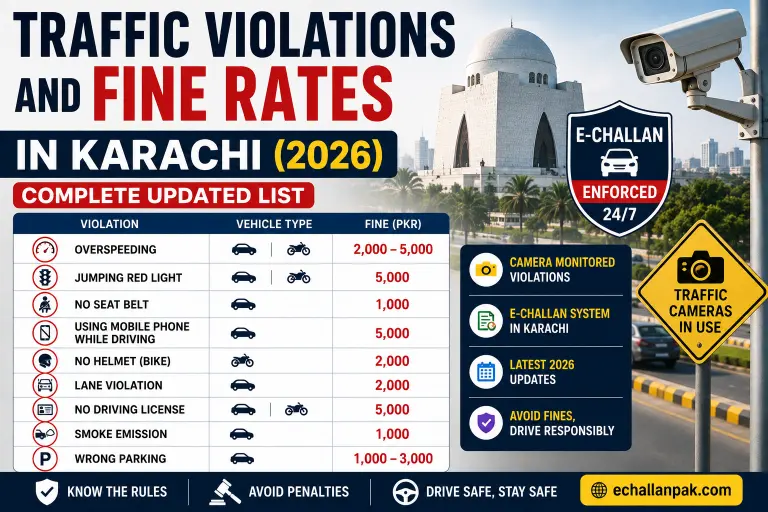
Karachi Traffic Fines by Violation Type
The table below reflects the confirmed structure from Sindh’s revised penalty schedule. Where exact province-wide figures weren’t specified for a violation, typical enforcement ranges are noted — always confirm the precise amount on your own challan, since some fines vary by zone or repeat-offense history.
| Violation | Motorcycle | Car / Jeep | Heavy Vehicle | Demerit Points |
|---|---|---|---|---|
| Overspeeding | Rs. 5,000 | Rs. 15,000 | Rs. 20,000 | 8 |
| Driving without a valid license | Up to Rs. 50,000 | Up to Rs. 50,000 | Up to Rs. 50,000 | 6 |
| Reckless / careless driving | Rs. 25,000 | Rs. 25,000 | Rs. 25,000 | 8 |
| Signal / red light violation | Varies by zone | Varies by zone | Varies by zone | 4 (typical) |
| Wrong-way driving | Varies by zone | Varies by zone | Varies by zone | 6–8 |
| Riding without a helmet | Applicable | N/A | N/A | Applicable |
| Tinted windows | N/A | Applicable | N/A | Applicable |
| One-wheeling | Applicable | N/A | N/A | High-priority offense |
What Are Demerit Points, and Why Do They Matter More Than the Fine?
Paying the fine doesn’t clear the record the way it used to. Under the current system, many violations attach demerit points to your driving history in addition to the rupee amount.
Points accumulate over time. Rack up enough of them, especially from high-point violations like overspeeding or reckless driving, and you risk license suspension — regardless of whether you paid every fine on time. This is a meaningful shift from the older system, where paying the challan was effectively the end of the matter.
Practical takeaway: a single Rs. 5,000 overspeeding fine on a motorcycle might feel minor, but the 8 demerit points attached to it carry real long-term weight if it happens more than once.
Why Do Motorcycles, Cars, and Heavy Vehicles Pay Different Amounts?
Sindh’s revised schedule deliberately tiers fines by vehicle class rather than applying a flat rate. Heavier vehicles generally carry higher fines for the same violation, reflecting the greater risk they pose in a collision. Public service vehicles and commercial transport are typically held to the higher end of the range as well, particularly for violations like overloading and reckless driving.
If you drive more than one type of vehicle — say, a personal car and a company pickup — don’t assume the fine you paid for one applies equally to the other.
How Karachi’s Camera Network Enforces These Fines
Most of these violations are now caught automatically rather than by an officer flagging you down. If you want the full picture of where enforcement is concentrated across the city, including which roads carry the densest coverage under Sindh’s expanding Safe City network, our camera locations guide covers that in detail once it’s live on your site.
What to Do If You Get a Fine You Don’t Recognize
Not every challan is accurate. A common and legitimate dispute reason in Karachi is a cloned or duplicated number plate, where a violation was actually committed by a different vehicle carrying a fake copy of your plate. If the violation, date, or location genuinely doesn’t match your movements, that’s worth formally disputing rather than paying and moving on.
Before assuming an error, though, check your challan status directly and review any photo or video evidence attached — most camera-issued challans include it.
How to Pay a Traffic Fine in Karachi
Once you’ve confirmed a fine is accurate, paying online is faster than visiting a counter, and it’s worth doing before your payment deadline to avoid late fees stacking on top of what you already owe — especially now that some violations carry demerit points that don’t disappear just because the fine gets paid.
Can You Formally Appeal a Traffic Fine in Karachi?
Yes, and it’s a separate process from simply flagging an error online. If you want to contest a violation formally rather than just checking the evidence, you’ll typically need to visit a traffic facilitation counter or district traffic office with your CNIC, vehicle registration documents, and the challan reference number.
Bring anything that supports your case — GPS logs, dashcam footage, proof the vehicle was sold before the violation date, or evidence of a cloned plate. Filing an appeal doesn’t pause your payment deadline, so most drivers pay the fine first and pursue a refund if the appeal succeeds, rather than risk late fees stacking up during the review period.
Keep a copy of everything you submit, along with any case or acknowledgment number you’re given — you may need it if the review takes longer than expected.
Common Violations That Carry Extra Consequences Beyond the Fine
A few violations under the current system come with follow-on effects worth knowing about:
- Driving without a license — beyond the Rs. 50,000 fine, this can complicate insurance claims if you’re involved in an accident.
- Wrong-lane and lane violations — often paired with signal violations at busy intersections, compounding the total penalty.
- Reckless driving — the 8 demerit points here are among the highest on the list, on par with overspeeding.
- Tinted windows — frequently checked alongside document verification, so an expired registration can surface at the same stop.
Frequently Asked Questions
Has Karachi’s traffic fine structure actually increased recently?
Yes. Sindh’s government amended the Twelfth Schedule of the Motor Vehicles Ordinance, 1965 in late 2025, raising fines for overspeeding, reckless driving, driving without a license, and several other violations, while also introducing demerit points.
What’s the fine for overspeeding in Karachi right now?
Under the revised schedule, overspeeding carries a Rs. 5,000 fine for motorcycles, Rs. 15,000 for cars, and Rs. 20,000 for heavy vehicles, along with 8 demerit points. Always confirm the exact figure on your own challan, since older guides may still show pre-revision amounts.
Do demerit points actually affect my license?
Yes. Points accumulate over repeated violations, and high point totals can lead to license suspension, separate from whether you’ve paid the associated fines.
Is the fine the same for a first offense and a repeat offense?
Not necessarily. Repeat offenders can face escalated penalties and faster point accumulation, even when the base fine for the violation itself stays the same.
Can heavy vehicles get a lower fine than cars for the same violation?
No — the current structure tiers fines by vehicle class, and heavier vehicles are generally fined at or above the rate applied to cars for equivalent violations.
What should I do if I think my fine amount is wrong?
Compare it against your actual challan first, since posted rate guides can lag behind official updates. If the amount still looks incorrect, or the violation itself doesn’t match your vehicle’s movements, you can formally dispute it with supporting documentation.
Do all traffic violations in Karachi carry demerit points?
No. Points are attached mainly to higher-risk violations like overspeeding, reckless driving, and driving without a license. Minor documentation or parking issues typically carry a fine without points.
This guide is for informational purposes only and is not affiliated with Sindh Police, the Sindh Excise & Taxation Department, or the Government of Sindh. Fine amounts and demerit point rules are subject to official revision — always verify the amount shown on your own challan.

Azam Malik is the founder of echallanpak.com, a platform dedicated to helping users in Pakistan check their traffic e-challan quickly and easily. He focuses on building simple, user-friendly online tools and guides that make government-related processes more accessible to the public.
With a strong interest in web development and digital solutions, Azam Malik ensures that all content on the site is clear, accurate, and regularly updated for a better user experience.
Note: echallanpak.com is an independent informational website and is not affiliated with any government authority.