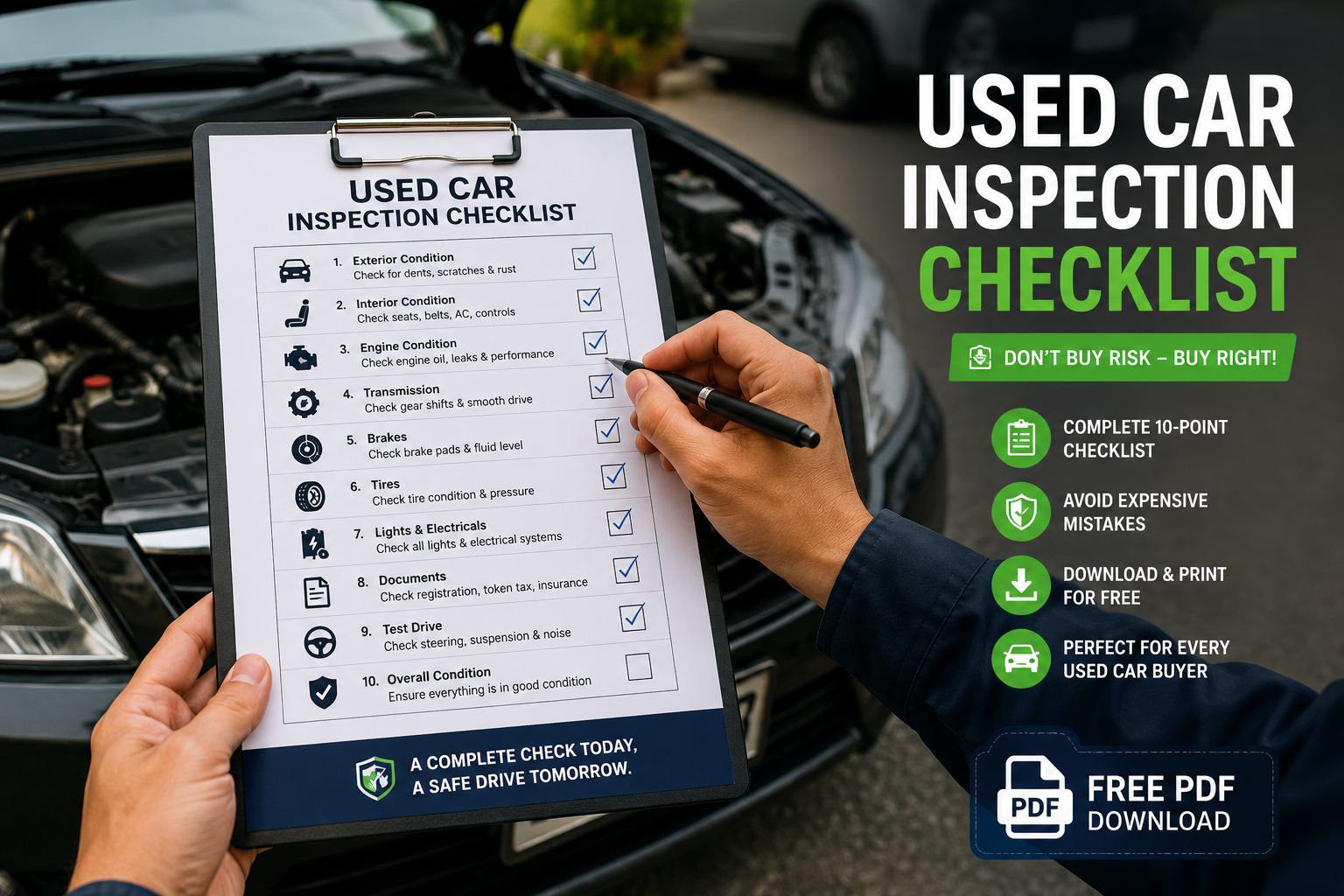
📥 Download Car Inspection Checklist — one-page, printable, Car Inspection Checklist, checkbox format.
TL;DR
Buying a used car in Pakistan without inspecting it properly can cost you lakhs in hidden repairs — or worse, land you with a vehicle that has unpaid e-challans, a mismatched chassis number, or an open bank loan against it. This guide walks through every inspection stage that matters — exterior, engine, undercarriage, interior, test drive, and paperwork — and explains why each one matters. Download the free, printable Used Car Inspection Checklist PDF above to take with you to the seller’s location, or use our interactive Vehicle Pre-Purchase Checklist tool if you’d rather check it off on your phone.
Key Facts
| Fact | Detail |
|---|---|
| Inspection stages | 6 — exterior, engine bay, undercarriage, interior, test drive, documents |
| Most overlooked check | Pending e-challans and hypothecation (bank loan) status |
| Common red flag | Mismatched paint shade between adjacent panels (signals prior accident repair) |
| Format | One-page printable PDF, checkbox style |
| Best used | Physically, at the seller’s location, before final price negotiation |
Why does a used car need a structured inspection, not just a test drive?
A short test drive only tells you how the car feels right now, not what’s wrong underneath. Engine oil condition, chassis integrity, and legal ownership status don’t reveal themselves in five minutes on the road. A structured, stage-by-stage inspection — done in a fixed order — reduces the chance of missing something a seller may be hoping you don’t check.
What should I check on the exterior and body?
Start outside, in daylight, before touching the engine.
- Check panel gaps on doors, bonnet, and boot — uneven gaps suggest a past collision.
- Compare paint colour across all panels under sunlight; a slightly off shade usually means a repaint.
- Look for ripples, overspray, or masking tape lines near edges and trim.
- Inspect tyres for even wear and matching brand/size across all four.
- Check the windscreen for deep cracks or chips beyond the wiper area.
- Test all lights, indicators, and the horn.
What should I check in the engine bay?
Pop the bonnet before starting the engine, and again after it’s warmed up.
- Look for oil leaks or wet patches around the engine block and gasket lines.
- Check engine oil colour on the dipstick — golden or brown is normal; black or milky is a warning sign.
- Check coolant level and colour; an oily sheen on coolant can indicate a head gasket issue.
- Inspect belts and hoses for cracks or fraying.
- Start the engine cold and listen for knocking; watch the exhaust for unusual blue, white, or black smoke.
- Confirm the engine and chassis numbers match the registration book — this is a legal check, not just mechanical.
Why does the undercarriage matter, and what does flood damage look like?
The undercarriage is where accident damage and flood damage are hardest to hide, because most buyers never check underneath the car.
- Rust or flaking: Normal light surface rust is common in older cars; heavy corrosion or flaking metal is not.
- Fresh weld marks: A sign the frame may have been repaired after a major accident.
- Silt or water staining: A strong indicator of flood exposure, which can cause long-term electrical and engine problems even if the car looks fine on the surface.
- Exhaust soot patterns: Uneven or excessive black soot can point to engine tuning issues.
What interior and electrical checks are easy to skip but shouldn’t be?
Interior checks take a few extra minutes but catch problems that are expensive to fix later.
- Check seats, dashboard, and door trim for tears or sun damage.
- Run the AC and confirm it cools within two to three minutes.
- Test power windows, central locking, and mirrors.
- Compare the odometer reading against the general wear on pedals and the driver’s seat — a low reading with heavy wear is a red flag.
- Confirm all dashboard warning lights clear after startup.
- Check for the spare tyre, jack, and toolkit.
What should I pay attention to during the test drive?
- Brake in a straight line and check the car doesn’t pull to one side.
- Shift through all gears and confirm the clutch bites smoothly, not too high or too low.
- Drive over a speed bump or rough patch and listen for knocking or clunking.
- Hold the steering straight at speed and check for vibration.
- Confirm brakes feel firm, not spongy or delayed.
What documents and legal checks matter most in Pakistan?
This is the stage most inspection checklists — including generic international ones — completely miss, and it’s often more financially risky than a mechanical fault.
- Original registration book — not a photocopy. Photocopies are a common red flag for disputed or stolen vehicles.
- Chassis and engine number match — cross-check both against the registration book, not just one.
- Seller’s CNIC matches ownership record — confirms you’re dealing with the actual legal owner.
- Token tax status — unpaid token tax becomes your problem the moment ownership transfers.
- Pending e-challans — unresolved traffic fines are tied to the vehicle, not the previous owner, in practice this often means the new owner ends up settling them. You can check this instantly using our e-challan and vehicle verification tool.
- Hypothecation (bank loan) status — some vehicles are still under an active leasing agreement; buying one without clearing this can mean the bank has a legal claim on your car.
What are the biggest red flags that mean you should walk away?
- Mismatched paint shade between adjacent panels
- Musty smell, water stains, or rusted seat rails (flood damage)
- Milky or foamy engine oil
- Odometer reading inconsistent with pedal or seat wear
- Seller unwilling to allow an independent mechanic’s inspection
- Chassis number that looks scratched, re-stamped, or unclear
- Only a photocopy of the registration book is available
- A price noticeably below market average for that model and year
Should I use the checklist tool or the printable PDF?
Both exist for different moments in the buying process:
| Interactive Tool | Printable PDF | |
|---|---|---|
| Best for | Quick digital run-through on your phone | Physical, on-site inspection with a pen in hand |
| Where to use it | Before you leave home, or in the car | Standing next to the vehicle at the seller’s location |
| Try it | Vehicle Pre-Purchase Checklist tool | Download below |
FAQs
Do I need a mechanic to inspect a used car, or is this checklist enough?
This checklist covers what any buyer can check without tools or expertise. For an expensive purchase, it’s still worth paying a trusted mechanic for a lift inspection, especially for the undercarriage and engine internals.
Can I check for pending e-challans before meeting the seller?
Yes. You only need the registration number to check for unpaid e-challans using an online vehicle verification tool, before you even schedule a viewing.
What if the chassis number doesn’t match the registration book?
Do not proceed with the purchase. A mismatched chassis number is a serious legal red flag and can mean the vehicle is stolen, tampered with, or incorrectly documented.
Is a car with an open bank loan (hypothecation) safe to buy?
Not without clearing it first. The bank retains a legal claim on the vehicle until the loan is settled, and that claim doesn’t disappear just because ownership changes hands informally.
Prefer to check it off digitally instead? Try our Vehicle Pre-Purchase Checklist tool.
Azam Malik is the founder of echallanpak.com, a platform dedicated to helping users in Pakistan check their traffic e-challan quickly and easily. He focuses on building simple, user-friendly online tools and guides that make government-related processes more accessible to the public.
With a strong interest in web development and digital solutions, Azam Malik ensures that all content on the site is clear, accurate, and regularly updated for a better user experience.
Note: echallanpak.com is an independent informational website and is not affiliated with any government authority.