Updated 2026 | by Azam Malik
🟢 TL;DR Quick Answer
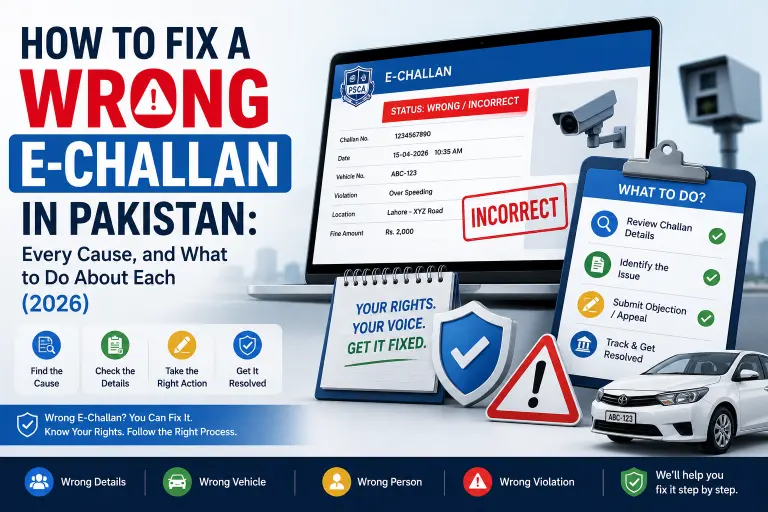
Wrong e-challans happen for four main reasons in Pakistan: a misread number plate, a cloned plate on someone else’s vehicle, a camera or system error, or an ownership transfer that was never updated. The fix differs slightly by cause, but the first step is always the same — verify the challan on your city’s official portal, gather evidence, and file a formal dispute. Never pay a challan you believe is wrong; payment is treated as acceptance of the violation.
📋 Key Facts
- Different cities have different issuing authorities: PSCA (Punjab), ITP (Islamabad), Sindh/Karachi Police, and KPK Traffic Police
- Most straightforward disputes resolve in 7–15 working days; complex cases like plate cloning take 15–30 days
- Never ignore a wrong challan — unpaid challans, even incorrect ones, can block token tax renewal and vehicle transfer
- If your dispute is rejected, escalation options exist through the Pakistan Citizen Portal or provincial ombudsman
How E-Challans Work — And Why Errors Happen
An e-challan is a digital traffic fine issued automatically by camera-based surveillance. When a vehicle violates a rule on a monitored road, the camera captures the plate, the system identifies the registered owner through NADRA records, and a challan is generated electronically — with no manual review before it’s issued. That automation is exactly why errors occur in the first place.
Different authorities manage this depending on the city:
- Punjab Safe City Authority (PSCA) — Lahore, Rawalpindi, and expanding Punjab cities
- Islamabad Traffic Police (ITP) — the federal capital
- Sindh Police / Karachi Traffic Police — Karachi and Sindh cities
- KPK Traffic Police — Peshawar and other KPK cities
Each has its own dispute process, covered below.
The Four Causes of a Wrong E-Challan
1. Misread Number Plate
ANPR cameras read plates using optical character recognition. A dirty, partially obscured, non-standard, or poorly lit plate can be misread — pulling up a completely different registered vehicle. This is the most common cause of wrong e-challans in Pakistan.
2. A Cloned or Fake Number Plate
This is a more serious situation: someone has fabricated a copy of your plate and put it on a different vehicle. When that vehicle commits a violation, the challan lands on your record because the plate matches yours in the database. This requires a distinct evidence trail — chassis number verification in particular, since a cloned plate can’t replicate your vehicle’s actual chassis number. We’ve covered this specific scenario in full depth, including the exact appeal steps and chassis-verification process, in our dedicated guide on what to do when your e-challan comes from a cloned number plate — if this is your situation, that’s the more detailed resource to use.
3. Camera or System Errors
No automated system is perfect. Camera angles, lighting, lens distortion, and software glitches can all produce an incorrect record — sometimes flagging a vehicle in an adjacent lane instead of the actual offender. Less common than a misread plate, but it does happen, particularly in cities where infrastructure is newer or still being calibrated.
4. Ownership Transfer Never Updated
If a vehicle was sold but the transfer was never completed in NADRA and Excise records, the old owner keeps receiving challans for violations the new owner commits. This is extremely common given how many private vehicle sales in Pakistan happen informally. If this is your situation, your real fix isn’t just disputing individual challans — it’s updating the ownership record itself. See our guide on what to do when vehicle ownership isn’t transferred on MTMIS for that process.
How to Fix It — Step by Step
Step 1: Verify the challan online. Check the official portal for your city — psca.gop.pk (Lahore/Rawalpindi), islamabadpolice.gov.pk (Islamabad), sindhpolice.gov.pk (Karachi/Sindh), or punjabpolice.gov.pk (other Punjab cities). Open the violation image and note the date, time, location, and vehicle shown. If the vehicle clearly isn’t yours — wrong model, wrong color, mismatched plate — you have grounds to dispute.
Step 2: Gather your evidence. CNIC copy of the registered owner, vehicle registration certificate, a screenshot of the challan showing the discrepancy, any proof of your location at the time (travel records, toll receipts, workplace logs), photos of your actual vehicle and plate, and — if cloning is suspected — an FIR from local police.
Step 3: Contact the relevant authority. Reach PSCA at (+92)-42-9905-1605(08), Islamabad Traffic Police at 1915, or Karachi Traffic Police through sindhpolice.gov.pk. Explain the situation clearly, referencing your challan number and the specific reason you believe it’s wrong.
Step 4: Submit a formal complaint. Online: go to your city’s portal, find the complaint or dispute section, fill in your challan ID, vehicle number, CNIC, and reason for dispute, upload your evidence, and save the reference number. In person: visit the nearest traffic police or PSCA office, bring originals and copies, ask for the e-challan dispute department, and request an acknowledgment receipt with a complaint number.
Step 5: Track it, actively. Don’t assume it’s being processed just because you submitted it. Call the helpline every few days if you haven’t heard back, visit in person if the online status doesn’t move within a week, and reference your complaint number every time.
What Happens After You File
The authority’s technical team reviews your case — cross-checking the challan image against your vehicle details, checking ANPR logs, and coordinating with police for serious cases like cloning. Typical timelines: 7 to 15 working days for straightforward errors like a misread plate, 15 to 30 days for complex cases like cloning or ownership disputes.
Three outcomes are possible: the challan is cancelled if the error is confirmed, corrected and transferred to the actual violator’s vehicle if the real offender is identified, or — rarely — the complaint is rejected if the authority determines the challan is valid, in which case you’ll be notified with reasons.
Why You Should Never Just Ignore a Wrong Challan
It’s tempting to assume an obviously wrong challan will just sort itself out. It won’t — the system has no way of knowing it’s wrong until you report it.
Late fees accumulate on an ignored challan regardless of whether it’s legitimate. Token tax renewal gets blocked in Punjab specifically if unpaid challans — including wrong ones — sit on your record. Vehicle transfer gets blocked too, which becomes a real problem if you’ve already sold the vehicle and the buyer’s transfer application gets rejected because of a challan attached to your name that you never resolved.
Disputing takes effort. Ignoring costs more, later, when you least expect it.
If Your Dispute Gets Rejected
Most wrong challans never reach this stage, but it’s worth knowing your options if yours does. If you’ve followed up repeatedly through official channels for over 30 days with no resolution, you can escalate through:
- Pakistan Citizen Portal (citizenportal.gov.pk) — a federal complaint platform that formally tracks unresolved government service issues
- Provincial Ombudsman — handles unresolved government complaints at the provincial level
- Legal counsel — worth considering for cloned-plate cases causing real financial or legal damage, where pursuing a formal case may be necessary
Preventing Wrong Challans in the First Place
- Keep your registration current. Complete ownership transfers immediately when buying or selling — not months later. An outdated record is one of the biggest sources of wrong challans landing on the wrong person.
- Avoid non-standard plates. Custom fonts or decorative styles are harder for ANPR cameras to read accurately, increasing your odds of a misread.
- Check your challan status regularly. A quick check every few weeks on your city’s official portal catches problems early, while you still have plenty of time to dispute before penalties build up.
Frequently Asked Questions
How can I check if my e-challan was issued by mistake?
Open your city’s official portal, enter your vehicle number, and view the challan image. If the vehicle or plate doesn’t match yours, you likely have grounds for a dispute.
Can I cancel a wrong e-challan online myself?
You can submit a dispute online, but the cancellation itself is confirmed by the authority after their verification — you can’t cancel it directly yourself.
Do I need to pay a challan before disputing it?
No. Never pay a challan you believe is wrong — payment is treated as acceptance of the violation, and reversing that afterward is much harder.
What if my dispute is rejected?
You can escalate through the Pakistan Citizen Portal, contact the provincial ombudsman, or pursue legal counsel for serious cases.
Can a challan for a vehicle I already sold still come to me?
Yes, if the ownership transfer was never completed in NADRA records — every challan continues going to whoever is still listed as the registered owner, regardless of who’s actually driving it.
My challan is specifically from a cloned plate — where do I go for the full process?
See our dedicated guide on e-challans issued on cloned number plates — it covers the chassis-number verification process and appeal steps specific to that scenario in full detail.
Disclaimer: This article is for informational purposes only. Dispute processes and timelines may vary by city and authority. For official complaint submission and resolution, always contact your city’s traffic police or Safe City authority directly.
Azam Malik is the founder of echallanpak.com, a platform dedicated to helping users in Pakistan check their traffic e-challan quickly and easily. He focuses on building simple, user-friendly online tools and guides that make government-related processes more accessible to the public.
With a strong interest in web development and digital solutions, Azam Malik ensures that all content on the site is clear, accurate, and regularly updated for a better user experience.
Note: echallanpak.com is an independent informational website and is not affiliated with any government authority.