Updated 2026 | by Azam Malik
🟢 TL;DR Quick Answer
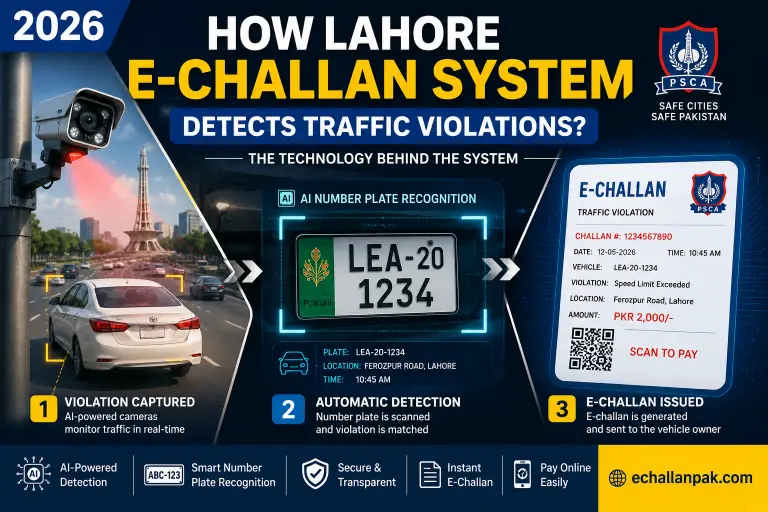
PSCA’s e-challan system in Lahore runs almost entirely without human involvement. ANPR (Automatic Number Plate Recognition) cameras detect a violation, read the number plate using OCR, cross-check it against NADRA’s vehicle database, and generate a digital challan — all within seconds. An SMS reaches the registered owner within 24–72 hours. No traffic warden needs to be present at any point in this process.
If you’re looking for step-by-step instructions to check or pay your Lahore e-challan, we’ve covered that in full detail in our Lahore E-Challan Check Online guide. This article instead answers a different question: how does the system actually work behind the scenes?
📋 Key Facts
- PSCA’s Safe City network covers Lahore with 8,000+ ANPR and CCTV cameras
- Violations are detected, verified, and turned into a challan automatically — no officer approves it manually
- The gap between violation and SMS notification is typically 24–72 hours
- Number plate misreads are the single biggest cause of wrongly issued challans
- Corruption at the enforcement level is structurally removed, since no human decides whether to issue a fine
Why This Matters to You as a Driver
Most people only think about the e-challan system after they’ve already been fined — they check the portal, pay, and move on. Few ever ask how that fine got generated in the first place, or why sometimes it’s wrong.
Understanding the mechanics actually helps in two very practical ways: it tells you what triggers a violation in the first place (so you can avoid one), and it tells you exactly what to check for if you ever need to dispute a challan that isn’t yours.
What Is the Punjab Safe Cities Authority (PSCA)?
PSCA is the Punjab government body responsible for city-wide surveillance and automated law enforcement. In Lahore specifically, it runs the entire smart camera network — ANPR systems, speed sensors, traffic signal integration, and the digital challan platform that ties it all together.
Traffic enforcement is actually just one part of PSCA’s mandate; it also handles emergency response coordination and general crime monitoring through the same camera network. But for everyday drivers, the e-challan system is the part that matters most.
The Safe City Lahore Project, in Context
Safe City Lahore is one of the largest urban surveillance rollouts in South Asia. Over 8,000 cameras now sit across the city’s main roads, intersections, signal points, and highways, all feeding into a single command center in real time.
The system combines several layers of technology working together:
- CCTV cameras for general area monitoring
- ANPR cameras dedicated to reading number plates
- Speed detection units at fixed points and along road sections
- Direct integration with traffic signal timing, so red-light violations trigger automatically
- A central command center that processes everything as it happens
It’s less “a bunch of cameras” and more a single connected system where every device reports to one place.
How a Violation Actually Becomes a Challan
This is the part most drivers never see. Here’s the real sequence of what happens once a camera catches something.
Step 1: The Camera Detects the Violation
Every monitored camera is watching for specific triggers — a vehicle crossing the stop line after the signal turns red, a vehicle exceeding the posted speed limit, or a vehicle moving through a restricted lane. The moment one of these conditions is met, the system captures the moment automatically. Nobody is watching a live feed waiting to catch you — the trigger is built into the camera logic itself.
For red-light violations specifically, PSCA’s cameras typically capture two images: one showing the vehicle at the stop line, and a second showing it inside the intersection after the signal has changed. That two-image sequence is what makes the evidence hard to dispute later.
Step 2: ANPR Reads the Number Plate
Within milliseconds, the ANPR software isolates the number plate from the image and reads it using optical character recognition (OCR). It then checks the result against Pakistan’s standard plate format.
This is also the weakest link in the entire chain. If a plate is dirty, damaged, non-standard, or partially obscured, the OCR read can fail or misfire — which is the single most common reason innocent vehicle owners end up disputing a challan that isn’t theirs.
Step 3: The System Verifies the Owner
Once the plate is confirmed, it’s checked against NADRA’s vehicle registration database. The system pulls the registered owner’s name, CNIC, linked mobile number, and vehicle details — make, model, and colour — to confirm the match.
Step 4: The Challan Is Created — Automatically
A digital challan record is created with the violation type, fine amount, date, time, camera location, and the captured image as evidence. No human reviews or approves this before it’s created — the entire point of the system is to remove that manual step so PSCA can process thousands of violations a day across the city.
Step 5: You Get Notified
An automated SMS goes out to the mobile number on file with NADRA, including the challan reference number and violation type. At the same time, the record becomes searchable on the official portal, where you can view the image, fine amount, and payment details.
This whole gap — from the moment the camera captures the violation to the SMS landing on your phone — usually takes 24 to 72 hours, depending on how much the system is processing that day.
What Kinds of Violations Actually Get Detected This Way
Not every violation is captured identically. The detection method genuinely differs by violation type, which is worth knowing if you’re trying to understand why some fines get issued instantly and others take longer.
Over-speeding is detected two ways — point-speed cameras that catch your exact speed at a fixed location, and section-speed detection that calculates your average speed across a stretch of road. Canal Road, Ring Road, and the major boulevards see the heaviest speed enforcement in Lahore.
Red light violations are the most automated of all, since the cameras are wired directly into the traffic signal timing. The dual-image capture described earlier makes this category the hardest to successfully dispute.
Lane discipline violations — driving in a bus-only lane, crossing solid lane markings, going against traffic in a one-way section — require more sophisticated camera setups and are currently only active at select high-priority locations, not city-wide.
Stop line crossing, where a vehicle edges past the line even before the light turns red, uses the same camera infrastructure as red-light detection and is becoming more common as coverage expands.
Why the System Actually Reduces Corruption
This is one of the more overlooked benefits of the whole setup. Before automated enforcement, roadside fine collection in Pakistan carried a real reputation for on-the-spot negotiation — a driver could often talk their way out of a fine, or pay a warden directly instead of the government.
The camera-based system removes that dynamic entirely, because there’s no officer standing there to negotiate with. The camera captures the violation, the software issues the challan, and the payment goes through a government portal. Nobody makes a judgment call on the road — which is exactly the point.
It also means enforcement is consistent. A monitored intersection applies the same rule at 3 AM as it does at rush hour, regardless of who’s driving or what they say.
Where the System Actually Breaks Down
No automated system is perfect, and PSCA’s is no exception. Being aware of these limitations is genuinely useful if you’re trying to figure out whether a challan you received is legitimate.
Technical delays happen periodically — server downtime, payment sync failures, and database update lags are common in large government IT systems. Most of these resolve within 24 to 72 hours, but they’re the reason your payment might not reflect immediately.
Number plate misreads remain the biggest source of wrongly issued challans. Lahore has a lot of vehicles with non-standard, worn, or dirty plates, and OCR simply isn’t 100% reliable against poor-quality input. If you ever get a challan that doesn’t match your vehicle, this is almost always why.
Public awareness gaps are still real. A large share of drivers, particularly outside the city’s tech-savvy demographic, still don’t know how to check their challan status online or understand that ignoring a fine eventually affects their token tax renewal and vehicle transfer.
Checking, Paying, or Disputing Your Challan
Since this article is focused on how the detection and issuance system works, we’ve kept the practical how-to steps in our dedicated guides so you’re not reading the same instructions twice:
- To check or pay your Lahore e-challan step by step, see our complete Lahore E-Challan Check Online guide
- If you believe a challan was wrongly issued — often due to the plate misread issue explained above — that same guide walks through the dispute and complaint process in detail
One thing worth flagging here specifically, since it ties directly into how the system works: if the violation image on your challan shows a different vehicle, a mismatched plate, or a location/time that doesn’t line up with where you were, that’s a strong sign of an ANPR misread rather than an actual violation — and it’s grounds for a dispute.
If you need to reach PSCA directly, their official contact details are:
- Phone: (+92)-42-9905-1605(08)
- Email: info@psca.gop.pk
- Address: PPIC3 Center, Qurban Lines, Lahore, Pakistan
Frequently Asked Questions
How does PSCA actually detect a traffic violation?
Through a combination of ANPR cameras, speed sensors, and direct integration with traffic signal timing. Each trigger — like crossing a stop line after a red signal — causes the system to automatically capture the violation, read the plate, and start the challan process, all without a human in the loop.
Why do number plate misreads happen, and how common are they?
They happen when OCR software struggles to read a plate that’s dirty, damaged, non-standard, or partially obscured. It’s the most common cause of wrongly issued PSCA challans in Lahore.
How long does it take between a violation and the SMS notification?
Typically 24 to 72 hours, covering ANPR processing, NADRA verification, challan creation, and SMS delivery.
Is a human involved at any point before the challan is issued?
No. The entire detection-to-challan process is automated. Operators at the command center only step in afterward, for tasks like reviewing disputed challans.
Does the automated system actually reduce corruption?
Yes — by removing any human decision point at the moment of enforcement, there’s no opportunity for on-the-spot negotiation the way there was with manual traffic policing.
Which violations are covered by this system in Lahore?
Over-speeding, red light violations, lane discipline violations, and stop line crossing are the main categories currently detected through PSCA’s camera network, with red light and speed detection being the most mature.
Disclaimer: This article is for informational purposes only and is not affiliated with PSCA or the Punjab government. For official records, payments, or disputes, always use the official PSCA portal or their helpline.
Azam Malik is the founder of echallanpak.com, a platform dedicated to helping users in Pakistan check their traffic e-challan quickly and easily. He focuses on building simple, user-friendly online tools and guides that make government-related processes more accessible to the public.
With a strong interest in web development and digital solutions, Azam Malik ensures that all content on the site is clear, accurate, and regularly updated for a better user experience.
Note: echallanpak.com is an independent informational website and is not affiliated with any government authority.