Last Updated: 2026
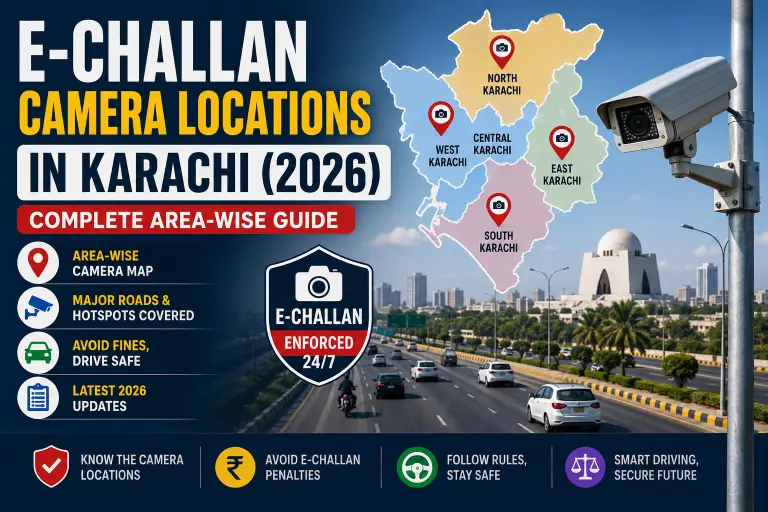
Quick Answer: Karachi’s e-challan cameras run under the Sindh Safe City project and cover major roads including Shahrah-e-Faisal, Lyari Expressway, University Road, M.A. Jinnah Road, and DHA/Clifton. A newly approved Phase-II expansion is adding over 2,300 more cameras citywide in 2026, with the heaviest coverage going to District South and District East. Cameras use ANPR (Automatic Number Plate Recognition) technology to read plates and issue digital challans automatically, without an officer present.
Key Facts
- Karachi’s Safe City network is expanding under a newly approved Phase-II project, adding 2,314 new smart cameras citywide.
- Of these, 1,300 are ANPR and facial-recognition cameras, with 80 dedicated purely to traffic enforcement.
- The expansion carries a budget of roughly Rs. 9.98 billion and is expected to roll out through 2026–2027.
- District South and District East will receive the highest concentration of new cameras.
- Cameras identify vehicles through plate recognition, not manual officer review, and cross-check against Excise vehicle records.
- Camera-issued challans typically appear online within a few days to a week of the violation.
What’s New in Karachi’s Camera Network for 2026?
This is the part most existing guides miss, because it only became public in April 2026: Sindh’s government approved a major second phase of the Karachi Safe City Project, expanding well beyond the original camera rollout.
The new phase adds 2,314 smart surveillance cameras across the city. That breaks down into 870 general surveillance cameras, 1,300 cameras equipped with ANPR and facial recognition, 80 dedicated specifically to traffic enforcement, 56 mobile surveillance units, and 8 focused on traffic signal monitoring.
Coverage isn’t spread evenly. District South is getting the largest share at 322 cameras, followed by District East with 220. Korangi, Keamari, and Malir are receiving smaller but meaningful additions, while District West gets minimal coverage in this phase and District Central isn’t part of this rollout at all.
The project carries an estimated cost of Rs. 9.98 billion and is scheduled for completion within about a year, meaning drivers should expect noticeably denser camera coverage — especially in South and East Karachi — through late 2026 and into 2027.
What this means for drivers: areas that felt lightly monitored in 2025 are getting a lot more coverage in 2026. If you drive regularly through South or East Karachi, assume new cameras are active even on roads that weren’t previously known camera zones.
How Do Karachi’s E-Challan Cameras Actually Work?
Most guides tell you where the cameras are without explaining what they’re actually doing — which matters if you want to understand what triggers a challan.
Karachi’s traffic cameras rely primarily on ANPR, or Automatic Number Plate Recognition. Here’s the process in plain terms:
- A camera captures an image or video frame of your vehicle as it passes.
- Software isolates the number plate and converts it into readable text.
- That plate number is checked against the Excise & Taxation vehicle database to confirm ownership.
- If the vehicle’s speed, signal timing, or lane behavior violated a rule, the system logs it as a violation with a timestamp and photo/video evidence.
- The challan is generated automatically and pushed to the online system — no officer has to be present or review it in real time for most standard violations.
Newer ANPR units installed under the Safe City expansion are built to read plates accurately even at night and in low light, closing a gap that let some nighttime violations slip through in earlier camera generations.
This matters practically: a dirty, damaged, or obscured plate doesn’t make you invisible to these systems — it just increases the odds of a misread, which is one of the most common grounds for a successful challan dispute (more on that below).
What Types of Cameras Are Used in Karachi’s E-Challan System?
| Camera Type | What It Detects | How It Works | Typical Fine Range |
|---|---|---|---|
| ANPR / Speed Camera | Overspeeding | Radar or plate-timing between two points | Rs. 500–3,000 |
| Red Light Camera | Crossing the stop line after signal turns red | Triggered by signal-status sensor + plate capture | Rs. 2,000 |
| Signal/Junction Camera | Illegal U-turns, wrong-way driving, lane violations | Fixed camera monitoring intersection behavior | Rs. 1,000–3,000 |
| Facial Recognition + ANPR (Safe City Phase-II) | Vehicle + occupant identification for security and traffic | AI-based recognition linked to command center | Varies by violation |
| Mobile Surveillance Units | Overspeeding and violations in non-fixed zones | Vehicle-mounted, relocated periodically | Rs. 500–3,000 |
E-Challan Camera Locations by Road and Area
Shahrah-e-Faisal
Karachi’s busiest corridor remains its most heavily monitored, connecting the airport to the city center. Expect active enforcement from the airport approach through Malir Halt, the PECHS/Tariq Road junction, and Drigh Road. Both speed and red-light cameras operate along this stretch, enforcing the standard limits set out in our road-wise Karachi speed limits guide.
Lyari Expressway
Cameras here focus almost entirely on speed enforcement, capping cars at 80 km/h. Motorcycles and heavy vehicles are prohibited on the expressway entirely, and mobile surveillance has increased around the Sohrab Goth and Mauripur Road entry/exit ramps as part of recent enforcement pushes.
University Road
A mix of fixed and mobile cameras covers Hassan Square, Safora Chowk, and the Samama Shopping Centre area, watching for overspeeding, red-signal violations, and the kind of lane and turning violations common near dense pedestrian zones.
M.A. Jinnah Road
Running through Karachi’s commercial core, this road sees dense daytime traffic and narrow lanes. Cameras concentrate around Tower junction, Regal Chowk, and the Jubilee Market area, mainly targeting speed and signal violations during rush hours.
Rashid Minhas Road
Coverage runs from the National Stadium area through Karsaz to the Malir Cantt approach, with speed cameras positioned along the more open stretches where drivers tend to accelerate.
I.I. Chundrigar Road
Karachi’s financial district sees dedicated signal-monitoring cameras aimed at wrong-way driving, illegal turns, and signal jumping, given the density of banks, offices, and pedestrian crossings.
DHA and Clifton
This area combines traffic enforcement with the city’s broader security camera network, given its high property values and VIP movement. Khayaban-e-Shaheen, Khayaban-e-Ittehad, the Clifton Underpass, and Sea View are among the most consistently monitored points, covering speed, red-light, and signal violations.
Korangi Road and Industrial Area
Cameras here focus on the industrial corridor’s mixed truck and car traffic, watching heavy-vehicle speed compliance near Korangi Crossing, the Landhi industrial entry, and Bilal Chowrangi.
Northern Bypass and Malir Expressway
Often left off older camera guides, these routes are increasingly monitored as Safe City coverage expands into Malir and the city’s northern edges. Expect speed enforcement at highway-style limits along stretches connecting to the M-10 and Super Highway.
How Long Does It Take for a Camera Challan to Appear?
Most camera-based violations show up in the online system within a few days to about a week. The delay exists because footage goes through automated plate-matching and, in some cases, a verification pass before the challan is finalized — this reduces false positives from misread plates or cloned number plates.
If you suspect you were caught on camera, check your challan status online daily for the first week rather than assuming no news means no violation.
Can You Dispute a Camera-Issued E-Challan in Karachi?
Yes, and disputes are more common than most drivers realize. Camera systems are accurate most of the time, but not perfect. Valid grounds for a dispute typically include:
- A misread or unclear plate number, especially on older or damaged plates.
- A cloned or duplicate number plate — a real and growing issue in Karachi, where a violation was actually committed by a vehicle wearing a fake copy of your plate.
- The vehicle was sold before the violation date and registration hadn’t been transferred yet.
- Duplicate challans for the same violation.
- A fine amount that doesn’t match the posted violation type.
To dispute, visit your district traffic office or a designated facilitation center with your CNIC, vehicle registration documents, and any supporting evidence — dashcam footage or GPS logs can help if you have them. Filing a dispute doesn’t pause your payment deadline, so many drivers pay online first and pursue a refund if the dispute succeeds, to avoid late fees stacking up during review.
Common Myths About Karachi’s E-Challan Cameras
“No number plate means no fine.” False — driving without a visible, legal plate is itself a serious violation with its own heavy fine, and vehicles without readable plates get flagged for follow-up rather than ignored.
“Cameras only work in daylight.” Not anymore. Newer ANPR units installed under the current Safe City expansion are built for accurate night-time plate reading.
“A camera flash means you’re definitely getting a ticket.” Not always — some flashes are from general surveillance or facial-recognition units unrelated to a traffic violation.
“You can dispute your way out of any camera violation.” Disputes work for genuine errors — misreads, cloned plates, ownership issues — not simply because you disagree with being caught.
Tips to Avoid Camera Violations in Karachi
- Check posted speed limits before entering monitored corridors — 60 km/h is the default on main city roads unless signage says otherwise.
- Stop before the white line, not the signal pole, to avoid red-light camera triggers.
- Keep your number plate clean and undamaged — a misread plate can complicate disputes even when you weren’t at fault. You can check how your registration reads in the system if you’re unsure.
- Plan turns and lane changes early, especially near monitored intersections like Regal Chowk and Hassan Square.
- Check your challan status weekly, rather than waiting for an SMS that may not arrive if your registered number is outdated.
- Report a cloned plate immediately if you notice unfamiliar violations tied to your vehicle — this protects you from repeated false challans.
Frequently Asked Questions
How many e-challan cameras are active in Karachi right now?
Karachi already runs a large network of ANPR, speed, and signal cameras, and that number is set to grow significantly with the newly approved Safe City Phase-II, which adds over 2,300 more cameras through 2026 and 2027.
Which areas of Karachi are getting the most new cameras in 2026?
District South and District East are receiving the largest share of the new camera rollout, followed by smaller additions in Korangi, Keamari, and Malir.
Do Karachi’s cameras work at night?
Yes. Newer ANPR units installed as part of the current expansion are specifically built to read number plates accurately in low light and after dark.
Can a cloned number plate get me a false challan?
Yes, and this is one of the more common dispute reasons in Karachi. If a vehicle carrying a duplicate of your plate commits a violation, the challan may initially route to your registration until you dispute it with evidence.
Is there an official way to see where new cameras are being installed?
Camera rollouts are announced through Sindh Safe City Authority updates rather than a single live public map, so location guides need regular updates as new phases go live — which is exactly why coverage details from a year ago are often already outdated.
Do motorcycles get caught by the same cameras as cars?
Yes, though enforcement intensity varies by road. Motorcycles are barred entirely from routes like Lyari Expressway, and violations there are treated as a separate offense from simple overspeeding.
What should I do if I get a challan from a road I don’t remember driving on?
Check the photo or video evidence attached to the challan before assuming it’s an error. If the vehicle, date, or location genuinely doesn’t match your movements, that’s grounds to dispute it — particularly if plate cloning is a possibility.
This guide is for informational purposes only and is not affiliated with Sindh Police or the Sindh Safe Cities Authority. Camera locations and enforcement zones expand regularly — always follow posted signage as the final authority.

Azam Malik is the founder of echallanpak.com, a platform dedicated to helping users in Pakistan check their traffic e-challan quickly and easily. He focuses on building simple, user-friendly online tools and guides that make government-related processes more accessible to the public.
With a strong interest in web development and digital solutions, Azam Malik ensures that all content on the site is clear, accurate, and regularly updated for a better user experience.
Note: echallanpak.com is an independent informational website and is not affiliated with any government authority.
 English
 English
 Pashto
 Urdu